Wingman · fewer turns, same perfect data
Every turn is a chance to leave.
Wingman spends fewer of them.
A workflow asked one question at a time is a dozen turns — a dozen chances for someone to put the phone down. Wingman lets people answer the way they talk: one sentence fills every step it answers, the tap-through stays for whoever prefers it, and the record comes back validated and identical either way. Then the AI Concierge puts the same conversation on your website.
The turn is the unit of patience
One sentence. Every step it answers.
In our demo pizzeria, “a large cheese pizza, no extra toppings, and a cannoli — pickup” is nine answers across two cart lines: the category, the item, the size, the toppings, the quantity, the second item, and how it gets to them. Asked step by step, that is nine turns. Said once, it is one — and the only question left is anything else?
Tap by tap
Nine questions, nine answers, nine moments to drift off. Perfectly structured — and a form with nicer paint.
With Wingman
One sentence in, nine validated answers out, and the run moves straight to what is still missing. The same record the tap-through would have built.
Or any mix
Half a sentence and a couple of taps is just as good. One authored structure takes whatever the person gives it and builds the same record.
It reads ahead
The whole workflow is its map — every branch, list and cart line is known before a word is exchanged, so it can fill steps the person has not reached yet.
It asks only what is left
Half an answer is still progress. The pieces that are missing get asked; the ones already said are simply skipped.
Change your mind, keep your place
“Actually, make it delivery” re-prices the order, keeps everything that still fits, and asks again only what depended on the old answer.
Why every other AI conversation disappoints
Let them chat. But give the AI a mission.
Everyone has been promised conversational AI and handed a demo that impressed and a pilot that produced nothing usable. The models were never the problem. A conversation with no destination ends somewhere different every time — so you get transcripts instead of data, and no two look alike.
Here the workflow tells the AI three things before a single word is exchanged: what the goal is, what the valid options are, and what has to be collected. Now the person can say anything at all, and the AI's only job is to land that mission. Unstructured conversation in. Structured, validated, identical-every-time data out.
A chatbot improvises. This one has an objective, and it cannot finish without meeting it.
Fast where it should be
Taps are instant. The AI only reads words.
Most turns are not conversation at all — a tap on Large, a typed that's everything, a name, an email. Those are captured by the workflow itself, checked by exactly the validation a form would run, and answered with the next question in your own words, with no model in the loop. The AI is called only when someone types something that needs understanding — a sentence full of answers, a question, a change of mind.
A tap never waits on a model
The answer lands and the next question is back in a blink — nobody watches a typing indicator to pick a size.
Your words, not a paraphrase
The next question arrives exactly as you wrote it, and an order summary or a receipt is posted word for word — never retold by an AI.
AI where it earns its keep
Sentences, questions and second thoughts go to the model. It thinks harder only when the message needs it, and the rest of the run costs nothing extra.
The AI Concierge
Put the same conversation on your website.
One script tag, and your site has a branded AI whose mission is one of your workflows. It knows the whole map before the visitor types a word, turns what they say into validated answers, fills a real run, and opens a secure panel for payment or signature without ever leaving the chat.
Every conversation lands beside your rich messaging runs, answer by answer — the same data, the same reports, whichever door the customer walked through.
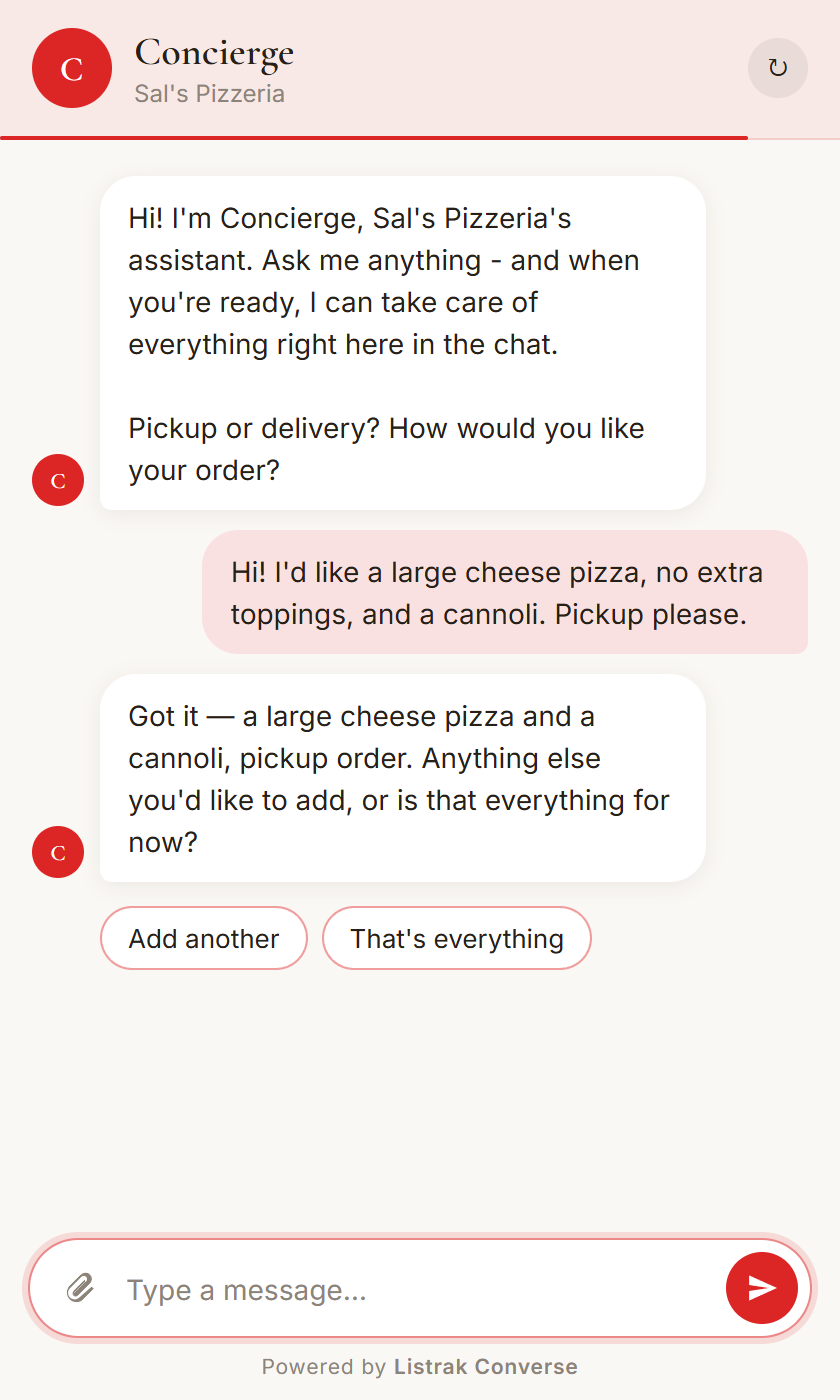
One sentence in. The order filled. One question left.
Money and consent stay theirs
It fills fast. It never decides for them.
Every answer has a receipt
The AI must quote the visitor's own words for anything it records. Words they never typed are refused, and a tapped button answers only its own question.
A price is a tap
A question that adds a charge, or one you mark as the customer's own decision, is never answered by the AI. “Sounds great!” is not a yes — it asks for one tap.
The rules still hold
“30, 45 or 60 minutes” means exactly that. An answer outside your rules is refused with the reason and asked again, on every channel.
Your model or ours
And it works with no AI at all.
Deterministic extraction fills structured answers with zero AI subscription, so the platform is fully usable before you have signed anything with a model vendor. AI prices the acceleration, never the basics. Bring your own key to make it sharper, and your data goes to your model rather than ours.
Why this is the magic
Designed conversation. Conversational intelligence. Perfect data either way.
The workflow is what makes the AI reliable, and the AI is what makes the workflow feel human. Neither works alone — a chatbot with no objective returns transcripts, and a form with no intelligence returns abandonment.
Start free
Let them just talk to you.
Build one conversation, turn Wingman on, put the Concierge on your site — and watch a paragraph become a complete, validated record.